

This post is part 4 in my series on leadership development. Check out the previous posts to follow along with the whole series.
I grew up going to a United Methodist Church, which means that I never heard the Bible faithfully taught, I never heard the gospel, I was not saved, and neither was the pastor. At this church, I did learn that the big numbers in the Bible were chapters, and the small numbers were verses, so at least I had that going for me. But that’s about the extent of my Bible knowledge until I got saved in college.
I did learn one other good thing from my Methodist upbringing. I learned that John Wesley was a boss.1
He was an 18th century minister who started Methodism during the First Great Awakening. He traveled around on his horse preaching the gospel from town to town and saw thousands of people come to Christ. He raised up more itinerant ministers to follow in his footsteps, and in a few decades, the Methodist Church was born.
Growing up, I never learned about any of this. I did remember one thing though. I would occasionally hear a church leader or two chuckle and grin, and say, “Oh that Wesley and his famous Holy Club”. It was like the only two facts anyone at my childhood church knew about Wesley were:
He started the Methodists, and
He was a part of the Holy Club.
When I took the time to study Wesley more, the pretentious-sounding “Holy Club” was my starting point because it was the only thing I knew. As I studied and read more books, I was stunned by what God had done. I realized that Wesley had started a Church Planting Movement, and the Holy Club was a cornerstone of this movement.
The Holy Club
The Holy Club was started by college students at the University of Oxford and consisted of John, his brother, Charles, who later wrote a bunch of the hymns you know and love, and George Whitefield, who may be the most famous preacher in American history. It also had at least 5 other people who have Wikipedia pages about themselves, so this was probably one of the most influential little clubs ever started at any college.
The Holy Club would meet together to discuss books, the Bible, confess sin, and track their moral behavior together. They did this for three hours every single day. Then they spent their leisure time giving to the poor, ministering to prisoners, and fasting twice a week. It’s like they learned about college debauchery, and went to the exact opposite end of the spectrum.
The other students at Oxford saw these buzz-kills meeting everyday and following strict, systematic rules, and mocked them by labeling them the Holy Club and Methodists.
But here’s the thing no one told me growing up about the Holy Club: the Wesley brothers, Whitefield, and the rest were not born again believers.
Movement Leaders Have Christlike Character

I made my shortest post ever to make a point: the key to moving from addition to multiplication is leadership development. When I started that post, I began thinking about everything that leadership development entailed, realized that I would need to write a book to get out all of my thoughts, and switched to keeping it as brief as possible to really dr…
The Grace-Based Correction
The Holy Club was doing all of these good works to try to become holy, not because they had already trusted in Christ to make them holy. Years later after they left Oxford, these friends all learned about grace and became true followers of Jesus. They continued to follow the disciplined pattern set by the Holy Club, but now this level of accountability came from a whole new perspective.
As Wesley began preaching his message of grace to crowds around England, others followed in his footsteps and surrendered to Christ. He formed them into regular gatherings called “Societies” where the believers could build one another up. Whoever was interested would meet in smaller, single gender groups called “Bands” to hold one another accountable in their walks with Jesus. These Band meetings were similar to the Holy Club, but now the Methodists were pushing one another to obey Jesus from a place of resting in God’s grace.
Band meetings were not required for Methodists, but they were required for any man who wanted to become a minister. A person could only become a leader after spending lengthy and consistent time in a Band.
Grace Based Accountability Groups
Following the Methodists’ example, after we have identified someone who is FAT, and has exhibited good character, the first thing we do is put this potential leader in a Grace-Based Accountability Group.
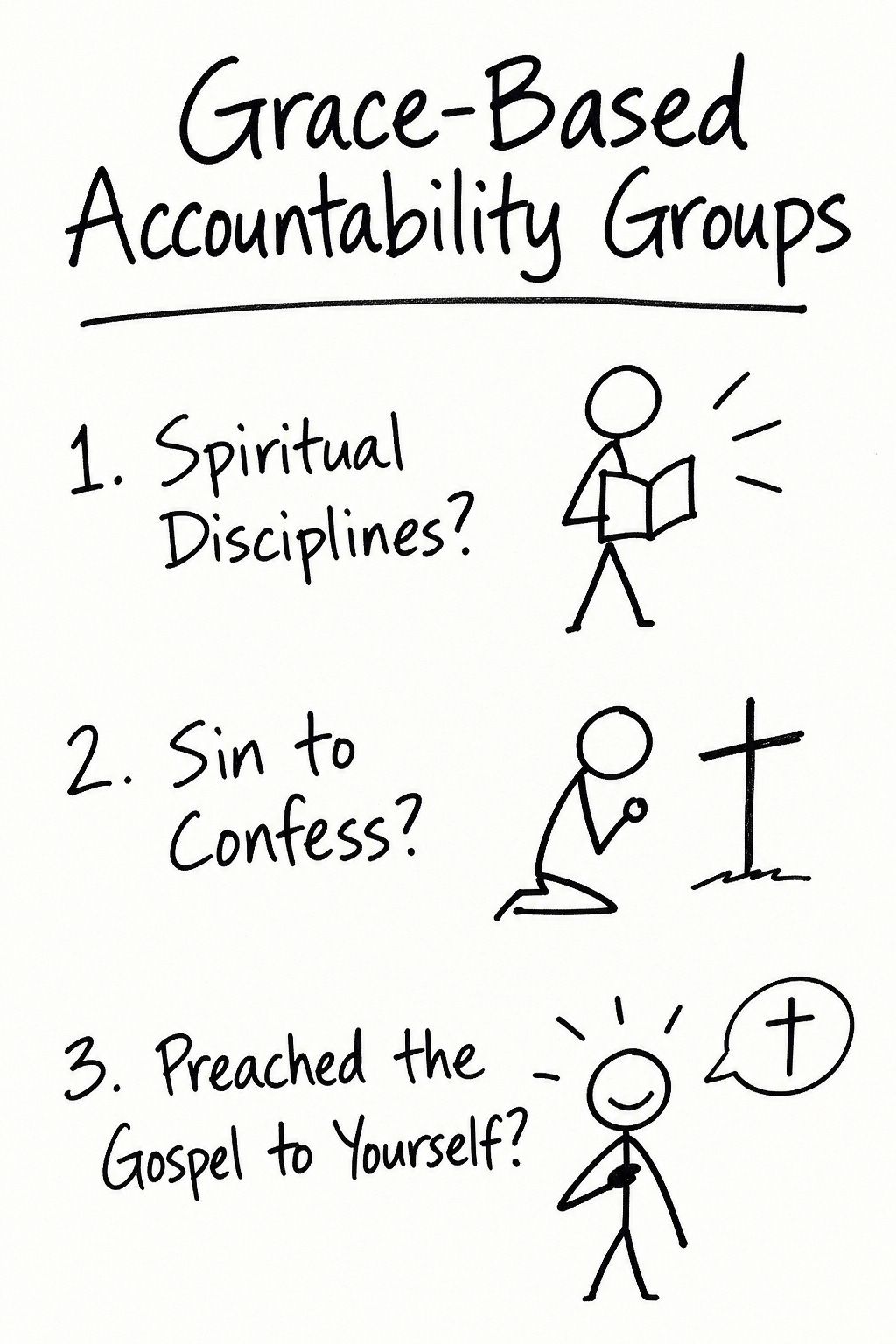
I’ve been a part of many accountability groups, and most have focused on confessing sin by asking one another a list of probing questions like,
Have you looked at a woman lustfully?
Have you gotten angry with anyone?
Have you lied?
This felt okay, but always left me longing for something more. It did not create the heart transformation I sought in my own life. When I looked around at other brothers in the group, I noticed that they weren’t experiencing much change either.
This sent me on a journey to figure out what to do differently.
One day, God brought the answer. I sat down with a group of other leaders, and we came up with a simple meeting structure centered around three aspects of following Jesus. We came up with questions to help dig deeper into each aspect.
Here’s the basic structure:
Abiding in Christ: What spiritual disciplines have been helping you grow in your relationship with Jesus? Which disciplines do you need to work on?
Confession of Sin: What sin have you been struggling with this week?
Preaching the Gospel of Grace to Yourself: How have you preached the gospel to yourself this week? Do you believe that Christ has forgiven you? Do you believe in your identity in Christ?
Why These Questions?
Confessing a list of sins, and repenting is good, but incomplete. God calls us to repent and believe in the gospel. Believing in the gospel is not only important for justification, but also sanctification.
Also, meeting once every week or two to talk with close friends is great, but still incomplete.
Jesus is the friend we need to be meeting with daily if we are going to be transformed by His Spirit.
That’s why we need questions to dig into repentance, belief, and abiding in Christ.
These three aspects are important biblically too:
Abiding in Christ: John 15:5, “I am the vine; you are the branches. The one who abides in me—and I in him—bears much fruit, because apart from me you can accomplish nothing”
Confession of Sin: 1 John 1:9, “But if we confess our sins, he is faithful and righteous, forgiving us our sins and cleansing us from all unrighteousness.”
Preaching the Gospel of Grace to Yourself: Galatians 3:2-3, “The only thing I want to learn from you is this: Did you receive the Spirit by doing the works of the law or by believing what you heard? Are you so foolish? Although you began with the Spirit, are you now trying to finish by human effort?”

Essential For Leaders
This is the starting point for developing leaders because Christlikeness is the foundation of their leadership. You must be a disciple who looks like Jesus if you want to multiply disciples who look like Jesus.
Not only this, but before New Testament disciples take on leadership positions, they are almost always described as people of high character:
The Seven: “Carefully select from among you, brothers, seven men who are well-attested, full of the Spirit and of wisdom, whom we may put in charge of this necessary task.” (Acts 6:3)
Stephen (who was one of the seven): “All who were sitting in the council looked intently at Stephen and saw his face was like the face of an angel.” (Acts 6:15)
Barnabas: “So Joseph, a Levite who was a native of Cyprus, called by the apostles Barnabas (which is translated “son of encouragement”), sold a field that belonged to him and brought the money and placed it at the apostles’ feet…he was a good man, full of the Holy Spirit and of faith” (Acts 4:36-37, 11:24)
Timothy: “The brothers in Lystra and Iconium spoke well of him.” (Acts 16:2)
Not only this, but the lists of requirements for elders in 1 Timothy 3 and Titus 1 are almost entirely lists of character traits.
If it was so important for the New Testament leaders to have godly character, then how can we prioritize it in our leadership development as well?
For the Methodists, a pursuit of holiness went hand-in-hand with revival. This has held true for all awakenings and revivals throughout church history, and even in Church Planning Movements today. Growing in character is an essential component for any movement of God.
When you help a potential leader grow in character, you are helping them become a disciple worth multiplying.
Want to learn more about Movements in America? —> Get The Book
Sign up to pray for my ministry! —> Pray
Donate to support my work —> Donate
In the slang sense. Does anyone actually use this as slang? Maybe it’s just me. Whatever…you get what I mean.
Great work. Going to re-read and see how I can apply!
Whoa cool - just wrote an article on Wesley yesterday! As always, good stuff brother