

This post is part 5 in my series on leadership development. Check out the previous posts to follow along with the whole series.
My wife is amazing. She is an amazing disciple maker. She makes disciples like Jesus.
A few years ago, my wife, Sara, led Savannah to Christ. After coming to Christ, Savannah spent many days and some nights over at Sara’s house (before we were married). They prayed, read the word, and sang worship songs. Whenever Savannah wasn’t at Sara’s house, she would pray, read the Word and sing worship songs on her own.
A few weeks before Savannah came to Christ, she went out praying and sharing the gospel in Sara’s neighborhood. Yes, she went evangelizing before salvation. She kept on evangelizing after salvation. Within a few weeks, she was pairing up with others besides Sara for these prayer walks. Soon, Savannah was organizing and leading her own prayer walks without Sara.
Savannah met with Sara’s church about two times before starting a church in her own home. Sara joined Savannah some to walk with her through this, but by the 7th or 8th gathering, Sara stopped attending, but coached Savannah when they would meet.
Now a few years later, Sara and Savannah are both married, have a few kids, both host churches in their own homes, and both invest in leaders who have started churches and groups themselves. They don’t see each other in person as much (way too much going on for that), but voice message each other almost nonstop.
This is the best example I have seen of someone training a disciple like Jesus did.
Jesus’ Model
When Jesus called his disciples to follow him and become fishers of men, they literally followed him. He didn’t do this with all of his disciples, but only the small group who he filtered to become leaders. Jesus taught them the skills of ministry by living with them.
Look at the lessons from Luke:
Jesus modeled how to fish for men:
“After this, Jesus traveled about from one town and village to another, proclaiming the good news of the kingdom of God. The Twelve were with him” (Luke 8:1)
Jesus assisted the disciples when they couldn’t do what Jesus taught them:
“‘A spirit seizes [my son] and he suddenly screams; it throws him into convulsions so that he foams at the mouth. It scarcely ever leaves him and is destroying him. I begged your disciples to drive it out, but they could not.’...Jesus rebuked the impure spirit, healed the boy and gave him back to his father” (Luke 9:39-40, 42)
Jesus watched his disciples as they went out to fish for men on their own:
When Jesus had called the Twelve together, he gave them power and authority to drive out all demons and to cure diseases, and he sent them out to proclaim the kingdom of God and to heal the sick…When the apostles returned, they reported to Jesus what they had done.” (Luke 9:1-2, 10)
Jesus left his disciples to fish for men after he ascended:
“repentance for the forgiveness of sins will be preached in his name to all nations, beginning at Jerusalem. You are witnesses of these things.” (Luke 24:47-48)
Do you hear the parallels between what Sara did and what Jesus did?
They both lived with their disciple. They both modeled the skills of making disciples. They both gradually let their disciples do more of the work. They both eventually stopped doing the work with the disciples.
If You Want To Be A Movement Catalyst, Stop Investing In Non-Multipliers

Filtering. It’s the hardest part in identifying movement leaders.
MAWL
What Jesus and my lovely wife demonstrate is the MAWL pattern:
Model: I do, you watch
Assist: I do, you do
Watch: You do, and report back to me
Leave: You do, I stay in touch
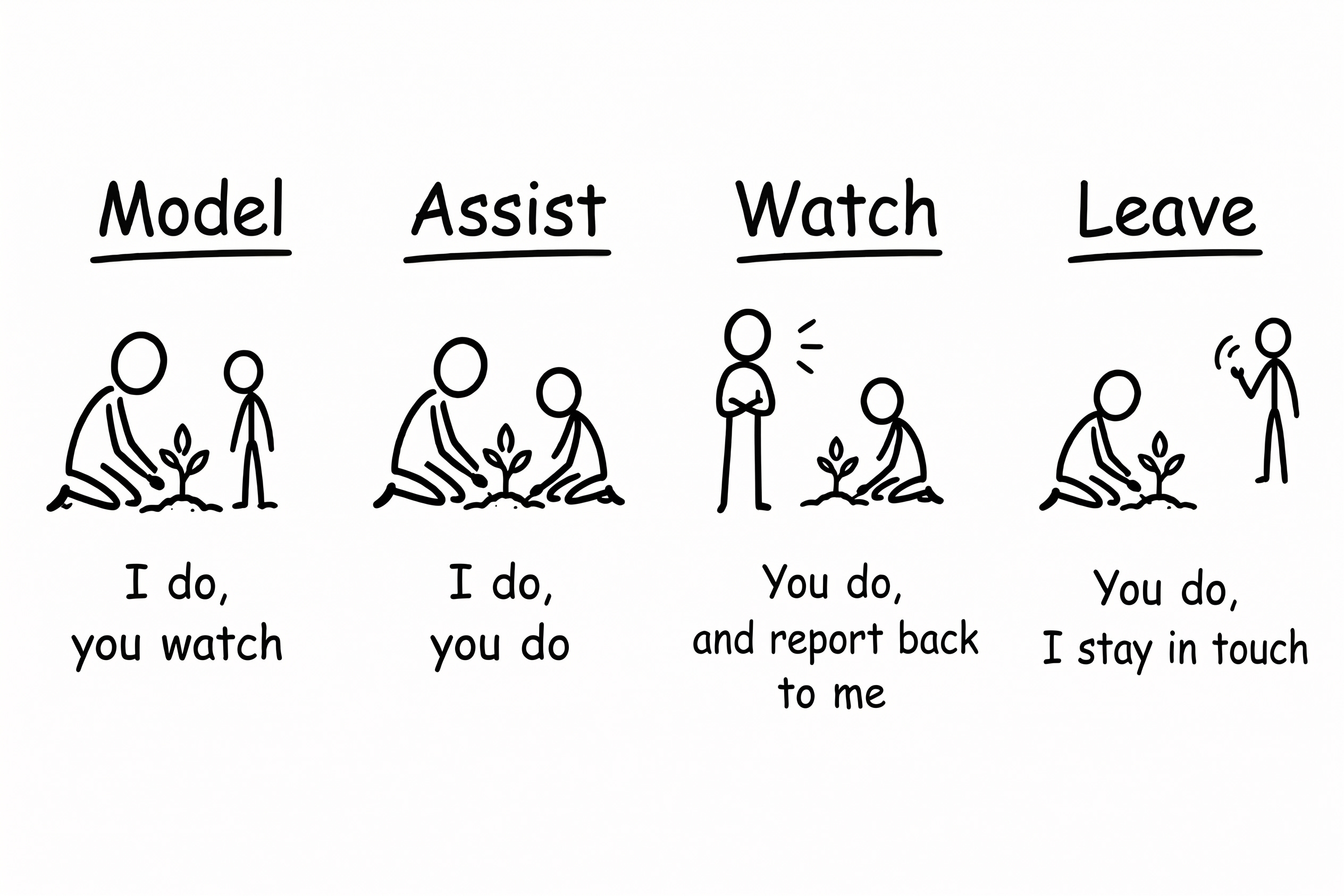
The MAWL cycle is the way Jesus trained his disciples and it’s what we’ve found to be the most helpful way to train our disciples too. Over time, I’ve learned some nuances that have greatly helped increase the effectiveness of this training approach:
Model
Only model 1-2 times before moving on to assist. The people you train will be wide-eyed and scared when you throw them into the deep end, but you will be there to reassure them. Their fear will turn to faith once they realize that they can do what you taught them. Model too much, and your disciple will become reliant on you.
Assist
Start with small ways they can assist in ministry, and day by day, give them more responsibility until they can do it all themselves.
Watch
This is where the rubber meets the road. This is the point you follow in Jesus’s footsteps and send the disciples out to do the work without you. When you check in, know that they will have adapted your training to their culture and personality.
It is your job as the discipler to see if what they are doing is still biblical and reproducible. If it is, encourage them to keep going. If it isn’t, go back to assist and do it with them again. If you have to go back to assist more than 2 times, the disciple is not FAT in this area, and you need to move on to training someone else.
Leave
Responsibility is fertilizer for leadership development. By leaving disciples to lead out in ministry, you are allowing them to grow to their potential. “Leave” usually makes people uncomfortable because it sounds like you are leaving the relationship, but that’s not true. You MAWL skills, not people. So you are leaving them to do the skills you have taught them. You are not leaving the relationship.

Look at the examples above. Sara stayed in touch with Savannah even after they stopped doing ministry alongside one another. Jesus sent his Holy Spirit when he ascended to heaven so that he wouldn’t leave his disciple alone. (John 14:16-18) Even if you are not there, you can trust that Jesus’s Spirit is with them helping them.
Maybe you can’t live with your disciple like Sara, but you can still apply the MAWL principle. Focus on how you can bring your disciple along with you in everyday life to show them how to be a disciple maker. In doing this, you will follow the pattern of Jesus and multiply disciples faster than if you train in a traditional, programmatic, classroom setting.
Want to learn more about Movements in America? —> Get The Book
Sign up to pray for my ministry! —> Pray
Donate to support my work —> Donate
You and I have amazing wives!
"Only model 1-2 times before moving on to assist." This was a good reminder... I usually go a few farther than that!